Stage 0
Hub Formation
Stage 0 is the season before the Myriad Pathway begins — the work the hub leader does to build their own team and identify the planters who will form the first cohort. It is not part of the five-stage journey the planters travel; it is the work that makes that journey possible. The hub leader recruits and forms their delivery team — hub administrator, facilitators, and the Myriad Hub Partner — establishes the practical infrastructure for running the pathway, and identifies and invites the lead planters who will join the first cohort.
This is also the stage at which potential mentors are identified and approached, so that induction can be completed before planters are paired after Mid Stage 1. Stage 0 has no fixed duration and no gathering, though we typically see startup periods between 6 and 12 months. It ends when the hub is ready and the first cohort is confirmed. Getting this stage right sets the conditions for everything that follows.
Welcome to Myriad!
We are delighted that you are launching a hub.
Your journey will likely have started long before you start talking to anyone about joining the hub as a planter, but we use the Kick Off meeting as a point when we officially launch your partnership with Myriad.
This page is designed for Hub Leaders, Hub Administrators and Myriad Partners and provides the resources needed to get your hub up and running. Therefore we ask all parties to familiarize themselves with the content on this page.
Outline Hub Formation Timeline
The Hub Formation journey can take 6+ months from the Kick Off meeting. In this time Hub Leaders will meet monthly with their Hub Partner to check on progress and discuss what needs to happen next. Each month there will be a different focus, as detailed below.
Come together with the key Myriad team including your Hub Partner. Our aim is to start off strongly, ensuring you have the right information and the right process in front of you, knowing you have help on hand.
Meet with your Hub Partner and David Vincent, Myriad's Head of Prayer to take a closer look at prayer in and around the Pathway, including the essential role of the Prayer Champion.
Meet with your Hub Partner and John McGinley to discuss how we provide support for Oversight Ministers and how to help them identify those people who could go on to lead a new church community.
Mentoring is one of the three crucial components of the Pathway. By empowering each planter with a missionally-minded leader to process challenges and pray with, this is a gift with an external perspective. Your Hub Partner along with Shiela Porter, Myriad's Mentor Coordinator, will talk you through what's needed and when.
By this time you are probably wondering what content is covered in the Pathway. At this meeting your Hub Partner will go through it with you in more detail, helping you see where a local flavour can be added to maximise its impact.
A Taster Event is a great opportunity to gather people, share the vision of church planting, and give them a sample of what it will be like on the Myriad Pathway alongside other like minded teams. In this meeting, your Hub Partner will run you through the programme and discuss how you can make it feel local whilst not losing site of the national picture of church renewal.
You're a month away from the first gathering and the official start of the Myriad Pathway. Gather your team of facilitators, prayer champion and administrator and be led through the content for G1 by your Hub Partner and Myriad Facilitator. Be prepared to deliver one or two pieces of input too.
Sharing the Opportunity
Recruiting planters is one of the most significant investments you will make in Stage 0 — and it is almost entirely relational. There is no shortcut. The people most likely to become planters are rarely looking for an opportunity; they are already doing something, already gathering people, already restless with a vision they haven't yet named. Your job is to find them, and the most reliable way to do that is through the leaders who already know them.
Start with church leaders. Personal conversations over coffee will almost always outperform any broadcast communication. Come with a clear, compelling vision — not a programme to sell, but a picture of what becomes possible when ordinary followers of Jesus are equipped and supported to form something new. When you meet, be prepared to help them understand:
- This is multiplication, not subtraction. Forming new church communities is part of the Great Commission — not a threat to an existing congregation. A planter who goes out from a church extends that church's reach into communities, networks and places it is not currently touching. The local church grows in influence, not shrinks.
- The person you're looking for is probably already in their congregation. Ask them to think about who has a missional instinct — who naturally gathers people, who has the trust and character to lead, who is restless in a way that a Sunday morning can't satisfy. That person often just needs someone to name what they're already carrying.
- Their involvement doesn't end at the door. The sending church leader plays a substantive ongoing role — providing oversight, pastoral support and accountability to the planter throughout the pathway. This is a partnership, not a handoff.
- Myriad provides the framework and the community. The planter won't be going it alone. They will have a structured learning pathway, a cohort of peers, a mentor and a hub team walking with them. The sending leader can release someone with confidence.
Don't overlook your own congregation. Some of your most fruitful early conversations may be closer than you think — there may be people already within your own church or network who are quietly carrying something and simply waiting to be invited.
Broaden your reach strategically. Once you have worked through your most immediate relationships, consider:
- Network and denominational leaders — find out if there are vocations days, pioneer pathways or mission conferences coming up where you could present or have a stand. These gatherings often attract exactly the kind of people you are looking for.
- Local Christian networks — particularly prayer networks and ecumenical groups, where leaders across traditions share a common concern for their area. These conversations can surface both potential planters and potential supporters.
- Theological colleges and ministry training courses — students approaching the end of their training, or recent graduates, may be at exactly the right moment to consider something new.
- Be patient and persistent. This process takes time and genuine investment in relationships. Most leaders will not have someone ready to put forward immediately — but a conversation planted now may bear fruit six months later when the right person surfaces. Keep the door open, follow up warmly, and let the vision do its work.
Message Templates
Here are some example messages that you are welcome to use but feel free to make them your own.
Subject: Coffee and a conversation — something I'd love to run by you
Hi [NAME],
Hope you and [family / the team at NAME OF CHURCH] are well. It feels like ages since we've properly caught up and I'd love to fix that.
I'm also writing with something on my mind that I think you'd find interesting — and honestly, I'd value your perspective on it.
Over the past [X months / year or so] I've been increasingly convicted of our need to plant new churches in the region, but not following the usual model. Instead, I've been praying and talking to the team at Myriad — they provide a pathway that trains and supports everyday people to form new church communities. Not professional church planters with big budgets, but ordinary followers of Jesus who sense a calling to something new — a housing estate, a workplace, a particular community — and need equipping, accompanying and a learning community around them to help them grow into it. It's been genuinely exciting and I've seen some remarkable things beginning to take shape.
I'd love to tell you more over coffee — partly because I think you'd get it, and partly because I suspect there might be someone in your congregation who is exactly the kind of person we're looking for. You probably know who they are already: that person with restless vision, a missional instinct and a community around them who'd follow them anywhere.
Would you be up for grabbing a coffee in the next few weeks? I'm flexible — just say the word and I'll work around you.
[YOUR NAME]
Subject: Could we find half an hour for a coffee?
Dear [NAME],
I hope this finds you well. We've crossed paths a number of times over the years through [shared network / denomination / context] and I've always appreciated your [ministry / leadership / work] — I hope things are going well at [CHURCH NAME].
I'm getting in touch because I'm working on something I think might resonate with you, and I'd love the chance to share it over coffee if you'd be open to it.
I've been praying a lot recently about the church in our region and am increasingly convicted that we need to do something new around forming churches. I've been talking with the team at Myriad, who can provide a structured, supported programme that trains and walks alongside people who are forming new church communities. We're not talking about large-scale church planting operations; we're talking about the person in your congregation who has a heart for a particular neighbourhood, a workplace or an unreached community and the makings of a team around them. People like that exist in most healthy churches — they're just rarely given the framework, the companionship and the training to step out with confidence.
I'd love to tell you more about what Myriad is and how it works. I'm also keen to hear your perspective — you know your congregation and your area well, and I suspect you might already have someone in mind who could be exactly who we're looking for.
Would you be willing to meet for coffee in the next few weeks? I'm happy to come to you. Just a reply to this email is all it takes.
With warm regards,
[YOUR NAME]
Dear [NAME],
I hope you're well. I'm writing because I think there may be a real opportunity for us to work together, and I wanted to put it to you directly.
I am working towards forming lead a Myriad hub in [AREA / DIOCESE / NETWORK]. Myriad is a 2.5-year pathway that trains and supports people who are forming new church communities — not large-scale church planting operations, but ordinary followers of Jesus who carry a calling to reach a neighbourhood, a network or a community that existing church is simply not touching. We provide the structure, the training, the mentoring and the learning community that turns that calling into something sustainable and fruitful.
What we find, again and again, is that the people who are most ready for this already exist within our churches and networks. They are not always in formal ministry. They often haven't been told that what they're carrying has a name, or that there is a pathway designed for people exactly like them. They turn up at vocations days. They sit in pews. They lead home groups. They run community projects. They are already gathering people — they just haven't been equipped or invited to go further.
That's where I think we could work together.
What I'd love to explore with you:
- Whether there is an opportunity for Myriad to be presented or represented at any vocations days, pioneer days or mission-focused gatherings you are running or planning — even a short slot to share the vision and let people self-identify
- Whether there are people already in your vocations pipeline who might be well suited to the pathway, and how we could make a referral or conversation easy
- Whether there is appetite within the diocese / network for a more formal partnership — for instance, Myriad being listed as a recognised pathway for those discerning a calling to pioneering or church planting
I appreciate that your vocations work carries a wide range of pathways and callings, and I'm not looking to add to your workload — I'm hoping this might actually serve what you're already trying to do. The people we are looking for are people you are already meeting.
I'd love to find half an hour for a conversation, in person or on a call, to explore whether there's something here worth pursuing together. I'm very happy to come to you.
With warm regards,
[YOUR NAME]
[HUB NAME / ROLE]
[EMAIL / PHONE]
Subject: Re: Coffee and a conversation
Hi [NAME],
I know inboxes fill up quickly so I just wanted to nudge this back to the top of yours — no pressure at all if the timing isn't right.
I reached out a couple of weeks ago about church planting — and the possibility of meeting for a coffee. I'd still love to do that if you're open to it.
Even just 30 minutes would be brilliant. I genuinely think there's something here that's worth you knowing about, and I'd value your thoughts.
[YOUR NAME]
Useful Resources

Am I called? is a short resource designed to help people discern if they are being called by God to go and form a new Christian community. This resource should be used by the team leader along with their sending church leader, who becomes their Oversight Minister.

Designed for church leaders, Who Plants Churches? is a short resource detailing the typical gifts, skills and experiences that we observe in most church planters.

Send Me is a collection of 14 stories of church planters, including how they came to discern God's call, the support they received and how their journeys started. Order from Amazon or ask your Myriad contact.
The research report Listening to the Voice of the Lay Planter was conducted in 2022 and has been the foundation of much of our team's work since then to create a purpose-built training pathway for non-ordained church planters. Freely available with an Executive Summary from CCX.
Marketing Materials
Looking for resources to help with publicity and social media? You can find many items here.
Although our experience is that one-to-one conversations with other church leaders will yield the best outcomes for recruitment, some media coverage can be very helpful.
Before the pathway can begin, you need to build the team that will deliver it.
The quality of the experience your planters have will depends directly on the people you recruit, equip and deploy here. Myriad's approach is to provide training - we provide each Hub with a Hub Partner who is the primary contact, walking alongside the hub throughout the pathway, training the local team as they go. At the first two gatherings, a second Myriad Facilitator may also attend to increase capacity and relieve some of the load of recruitment. There is a transfer of knowledge as the Pathway progresses so once it has completed, the local team will have enough understanding to do a second Pathway without direct Myriad help.
Who you are looking for
The hub team has four distinct roles — Administrator, Facilitators, Prayer Champion and Mentors — each described in more detail below. Across all of them, you are looking for people who combine genuine commitment to the mission of forming new church communities with the character and reliability to serve others well over a sustained period. These are not one-off volunteer slots; they are meaningful commitments that will shape the lives of the planters they support.
When identifying candidates, draw first on your own network — people you know, have worked alongside and can vouch for. Ask yourself not just whether someone has the skills for a role, but whether they have the maturity, the availability and the relational warmth to do it well over 2.5 years. It is better to take longer to find the right person than to fill a role quickly with the wrong one.
A note on culture
The hub team will set the culture that planters experience. If your team is warm, prayerful, well-organised and genuinely invested in the people they serve, planters will feel held. If it is fragmented, under-resourced or going through the motions, planters will feel that too. Invest in your team — meet together regularly, pray for your planters by name, debrief honestly after gatherings and celebrate what God is doing. The hub team is itself a new church community in miniature, and it deserves the same care and intentionality you are asking your planters to bring to theirs.
Good safeguarding practice applies to all hub team roles as a matter of principle — not because of any specific risk assessment of the planters themselves, but because a commitment to safe environments is simply part of how the church operates.
This means:
- A formal expression of interest or application for each role, so there is a record of who was considered and why they were appointed
- At least one substantive conversation or interview before any appointment is confirmed
- At least two references from people who can speak to the candidate's character and suitability — not just their competence
- All hub team members must complete the Church of England Basic Safeguarding Awareness training (or the equivalent for your denomination or organisation) before beginning their role. This is a straightforward online module and is a non-negotiable baseline for anyone serving in a church-related capacity
- Sight of relevant qualifications or training certificates where the role requires them
DBS checks are not required for most hub team roles, since the work does not constitute a regulated activity as defined under the Safeguarding Vulnerable Groups Act. However, if your hub is explicitly serving or working alongside a new church community that includes children or young people under 18, or adults at risk, then an enhanced DBS check will be required for any team member whose role brings them into regular contact with those groups. If you are unsure whether DBS checks apply in your context, check with your denominational safeguarding adviser before proceeding.
If you are operating within a denominational or organisational structure, ensure your recruitment process is consistent with any additional safeguarding policies that apply to you.
Before each hub team member begins their role, a simple working agreement should be completed and signed by both parties. This does not need to be a lengthy legal document — its purpose is to ensure that expectations are shared, understood and recorded.
A working agreement for hub team members should cover:
- The nature and scope of the role
- The expected time commitment per month and per stage
- The duration of the commitment (the full pathway, or a defined stage)
- Expectations around confidentiality — particularly in relation to planters and their communities
- How concerns or difficulties within the role should be raised
- The process for stepping back from the role if circumstances change
A template working agreement for each role is provided below. These should be treated as a starting point and adapted to reflect your own organisational context and any requirements from your oversight structure.
Role Descriptions
Subject: Could you be a mentor on the Myriad Pathway?
Dear [NAME],
I hope you're well. I'm writing with something I'd love to put to you — and I genuinely think it might be right up your street.
As you may know, I lead a Myriad hub in [AREA]. Myriad is a 2.5-year pathway that trains and supports people who are forming new church communities — ordinary followers of Jesus with a missional calling, being equipped and walked alongside as they step out into something new. It's one of the most rewarding things I've been involved in, and I hope to see some remarkable people grow into remarkable things through it.
One of the things that makes the biggest difference to our planters is having a good mentor — and that's why I'm writing to you.
What the role involves
We pair each planter with a mentor after the first few months of the pathway — someone who is a few steps ahead of them in missional leadership, who can walk alongside them with wisdom, experience and honest questions. It is not a coaching contract or a consultancy arrangement. It is more like being a trusted, experienced friend to someone who is doing something genuinely courageous.
In practice, this means:
- Meeting with your mentee twice per stage of the pathway — roughly every three months — for a conversation they will initiate and lead
- Receiving their action plan after each gathering so you can engage with where they are and what they're working on
- Being available by message or phone if something significant comes up between meetings
- Flagging anything you're concerned about to me as hub leader
The planter drives the relationship — they contact you, they set the agenda, they bring their questions. Your role is to listen well, ask good questions, offer the wisdom of your own experience and believe in them when it's hard. That's it. You are not responsible for their outcomes — just for showing up faithfully and honestly.
The commitment runs for approximately two years, with around two meetings per stage. It is not a large time commitment, but it is a meaningful one. Once the Pathway is finished, there is no expectation you will continue, but you and your planter might decide that you want to carry on.
Why I'm asking you
I'm asking because I think you have exactly what a good mentor needs — [ADD A SENTENCE HERE: e.g. 'you've pioneered in contexts that would resonate with what our planters are navigating' / 'you have a gift for asking the kind of questions that help people find their own clarity' / 'you know what it is to lead something from scratch and I think that experience would be invaluable']. I don't ask people lightly and I wouldn't be writing if I didn't think this was a good match.
What we offer you
We don't just ask and then leave you to it. Before you begin, we'll ask you to complete a short online Mentor Induction — it gives you the context, framework and tools you need to mentor well within the Myriad Pathway, and most people find it genuinely useful. If you've never done formal mentoring before, there's also an optional Mentoring Training course available. Both are accessible at linktr.ee/Myriad_Mentoring.
You'll also receive a Stage Handbook at the start of each stage, so you always have a clear picture of what your mentee has been working through. And I'm always available — if something comes up that you're not sure how to handle, you can pick up the phone to me. You will also need to confirm you have completed at least Basic Awareness Safeguarding Training (or equivalent from your denomination).
Would you like to find out more?
I'd love to have a conversation before you make any decision — there's no pressure here and I want you to go into this with your eyes open. If you'd like to chat, just reply to this email and we'll find a time. Equally, if you already know this is something you'd like to explore further, I'm delighted — and I'll explain what the next steps look like.
If you do decide to go ahead, the process is straightforward: a short application, two references from people who can speak to your character and suitability, and completion of the induction before you meet your mentee. This is part of our commitment to good safeguarding practice across the hub — it applies to everyone who serves on the team, and I want you to know that it reflects the seriousness with which we take this work, not any doubt about you personally.
I really hope you'll say yes — or at least say yes to a conversation. What you have to offer is exactly what our planters need.
With warm regards,
[YOUR NAME]
[HUB NAME]
[EMAIL / PHONE]
Subject: Could you be a mentor on the Myriad Pathway?
Dear xxxx,
Thank you for your interest in becoming a mentor for XXXXX Myriad Hub.
To complete your application please could you complete this application form giving us some basic information about your experience and includes a request for a referee we can contact.
We ask all mentors to demonstrate Safeguarding Awareness so please would you either send me your up to date certificate or complete the Church of England's Basic Awareness safeguarding training.
Finally here is a link to the Mentor Handbook that includes the Mentor Induction which we ask all mentors to complete.
Please can you contact me to confirm this when this is completed. Once we have all the information we need we will be looking at the Team Leaders in our Hub and will be in touch again if we have a suitable contact for you. This is likely to happen after the hub begins <insert date>
Thank you for taking time to offer to support our Hub as a mentor.
About
A Taster Event is a great opportunity to bring together those people who are exploring options on how best to form or establish a new church community. Their church leaders may want to attend as well. Each Hub Leader will be supported by their Hub Partner to deliver this event.
Over the course of 1h30 (online) to 2hrs (in person), you'll share the vision of Myriad and church planting, share a local story and give people a taste of what it will be like to journey together. There will be stories, explanation and interaction. By the end, we hope that many people will feel they understand what Myriad offers them and will then decide to go ahead.
Message Templates
Subject: An Invitation to discern what God is calling you to
Dear {First Name},
Across the country, we are seeing people stepping up to go and form new churches so that more people can be reached with the good news of Jesus. Some of them were very driven in what they were doing and others started off quite hesitantly. The results show that new people are coming to know Jesus and the church is growing in new places.
In response to this, we are starting our own training programme for people like this in our area and we would love you to consider being part of this. We have been in contact with (CHURCH LEADER NAME) and they have put your name forward so we would love to talk to you.
We believe that the best way for the church to reach new people in our area is to form new church communities where people are. But we know that this isn't a straightforward process and so we are partnering with Myriad to provide a new pathway for people such as yourself to go and form these new church communities.
You'll journey alongside other people and their teams as you work your way from the early stages of discernment (where, who, when) to planting to growth & multiplication. You don't need to have everything worked out up front or any particular qualification, but simply a willingness to prayerfully explore what the options are for you.
We would really welcome a conversation with you to explain more about this, and you may want to attend an upcoming "taster" event on XXXXX that will help explain more of what we are trying to do.
Every blessing,
Subject: Could we find half an hour for a coffee?
Dear friends,
I am following up with further news and instruction about the new Myriad Hub that is due to start XXXX @ YYYY.
As a church leader, my hope is that you will already see the gifts and skills of the people in your church and will be talking to those who are sensing the call of God to go on a missional adventure and form a new church community. Please find a couple of really helpful downloadable documents that may enable your discernment conversations.
- Am I called? - intended for you to share with those exploring a call to start a new church community
- Who Plants Churches? - intended for church leaders like you to help identify the call and gifting in others to start new church communities.
Myriad’s enrolment criteria is as simple as someone who:
- Can articulate something of the call of God to go and form a new church community;
- Is committed to the Myriad Pathway over 2 years as part of a team; and
- Is supported by you as their church leader (and who will provide ongoing support as their Oversight Minster).
Once you’ve identified such a person, you will “send them” to join a Myriad Pathway and you become their “Oversight Minister” within this context. It’s possible that this new church community will be formed under the umbrella of your own church. In this case, you are also responsible for ensuring your safer recruitment practices are followed. If this doesn’t work in your context please let me know and we can work out together what needs to happen.
To enrol on the Myriad Pathway, please ask your candidate to complete this application form. I will then write to you (assuming you are listed as their referee) and ask for a simple reference. With all of these details we will ensure together that they meet the enrolment criteria for Myriad and we can enrol them. I’ll also send you some induction materials, so that you are clearer on your role in the process as oversight minister. Myriad also runs regular training sessions in this area so you’ll hear about that too.
In the run up to the first gathering, your candidate will also need to start to gather their team; they will need at least one other person with them initially, with a view to having up to 6 people attend together as a team from gathering 3 onwards. If your candidate has already started to gather a team, that’s excellent. Please do help your candidate identify suitable people to join them in their call to start a new church community. They can’t do this work alone, so we want to emphasise the principle of ‘going with others’ and ‘working as a team’, right from the outset. You will also need to work through and apply your safer recruitment practices here too.
Lastly if you or your prospective candidates are interested in sampling a bit more of Myriad before committing, then we are running an online taster event on XXXX. We would love to see many people there to encourage each other and to get a flavour as to how Myriad Pathway will support them.
Do let me know if you have any questions…
Subject: Great to meet you — what's next?
Dear [NAME],
Thank you so much for coming along to our Myriad taster event on [DATE]. It was a real pleasure to meet you, and I hope you left with a clearer sense of what the pathway is and — perhaps more importantly — whether it might be for you.
I wanted to follow up personally, because the conversations I had on the day suggested that you might be exactly the kind of person we are looking for. You may not have used this word for yourself yet, but in Myriad we call them planters — people who carry a sense of calling to gather others around a vision of something new, in a place or community that existing church isn't currently reaching. If any part of what you heard on [DATE] stirred something in you, that's worth paying attention to.
What Myriad offers
Just to recap what we covered:
- A structured 2.5-year pathway, organised into five six-month stages
- Residential gatherings with a cohort of people doing the same thing — so you are never doing this alone
- A mentor who will walk alongside you personally throughout the journey
- Training, resources and a learning community designed specifically for people forming new church communities
You don't need to have it all figured out to apply. Most of the people who go through Myriad start with more questions than answers — that's the point. The pathway is designed to help you discern, shape and act on what God has put in you, alongside others doing the same.
The next step
If you'd like to take this further, I'd love to invite you to apply. The application is straightforward — it asks about who you are, where you sense God is calling you and what you're already doing. It is not a test, and there are no wrong answers. It's the beginning of a conversation.
You can apply at https://myriad.church/PathwayApplicationForm. If you have questions before you do, just reply to this email or give me a call — I'm very happy to talk it through with you first.
Applications for this cohort close on [DATE]. If that feels tight, please get in touch and we can talk about whether there is flexibility.
I genuinely hope you'll take the step. What you're carrying matters — and you deserve the support to do something with it.
With warm regards,
[YOUR NAME]
[HUB NAME]
[EMAIL / PHONE]
Subject: Following up from the Myriad taster — and a question for you
Dear [NAME],
Thank you for giving up your time to join us at the Myriad taster event on [DATE]. I hope it was useful and that you left with a clearer picture of what the pathway is and what it asks of the people who go through it.
I wanted to follow up with two things.
First — is there someone in your congregation?
The question I'd love you to sit with is this: is there someone in your congregation who could be a planter? You're probably better placed than anyone to know who in your community has a missional instinct, naturally gathers people, and carries a restless sense that there is something more they're called to. That person may not have the language for it yet — they may not even realise what they're carrying. But if someone comes to mind, I'd love to have a conversation about whether Myriad might be the right context for them to explore it.
If you'd like to explore that, the most natural next step is probably for the three of us to meet — you, them and me — so that you can hear more together and I can answer any questions either of you have. Just reply to this email and we can find a time.
Second — a direct invitation to apply
Depending on where you are in your own journey, I also want to extend a direct invitation to you. The Myriad Pathway is not only for those at the beginning of their leadership story — some of our most effective planters have been experienced church leaders who sensed God was calling them into a new chapter. If anything you heard on [DATE] resonated with something in you personally, please don't dismiss it.
If you'd like to apply — whether for yourself or to support someone from your congregation — the application is at https://myriad.church/PathwayApplicationForm and is open until [DATE].
As always, I'm very happy to talk any of this through. A coffee conversation costs nothing and often clarifies a great deal.
With warm regards,
[YOUR NAME]
[HUB NAME]
[EMAIL / PHONE]
Taster Event Content and Programme
Use the following content as a framework for the event. It would be helpful if the Hub Leader could organise:
- An act of worship
- A local story of a non-ordained church planter to help people recognise that this happens closer to home than they realise.
Slides
Taster Event Slides
Talk through these slides (39). There will be minimal opportunity for team working but time will be needed for interaction. It covers all G1 content at a high level.
PROGRAMME
Taster Event Programme
Play this video introduction (6mins).
recruitment and enrolment
The Hub Leader is responsible for enrolling team leaders to the Myriad Pathway. (Safer) Recruitment of the Leader and team for the new church community, is normally the responsibility of the sending church leader (Oversight Minister) on the assumption that in most cases, the new church community will operate under the umbrella of the sending church, at least to begin with.
Where a potential team is not operating under the umbrella of an existing organisation, the Hub Leader should encourage them to align with a church or network, such as the Kairos Connexion's Microchurch Network and/or Thirtyone:Eight, for support and good governance.
Team leaders, with the support of their sending church leader, are then responsible for the safer recruitment of team members. This is normally a lighter process for those teams who are at a very early stage of discernment.
An Oversight Minister does not need to complete an application form because they are not enrolling themselves onto the Myriad Pathway.
A Myriad Pathway is run by a Hub. Participants on the same pathway are collectively referred to as a cohort. A cohort is made up of a number of teams, each reflecting the leadership group of a new church community. Each team has a team leader, who is the person who is enrolled onto the Myriad Pathway. Whilst we expect the team leader to be consistent throughout the pathway (as they are the ones who primarily hold the vision of the new church community), team members may change more often. Each team should be between 2 and 6 people.
A cohort with 8 teams on a Pathway might look like this:
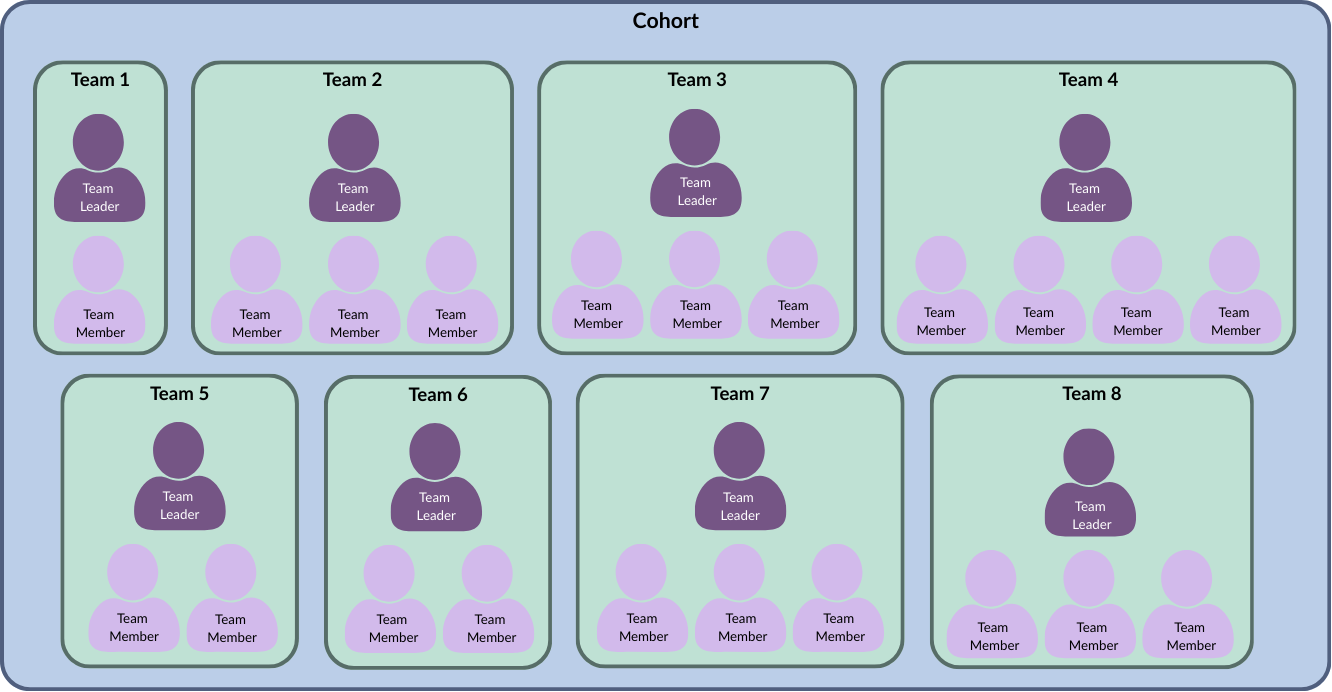
The Team Leaders (in dark purple) are the only ones who are enrolled onto the Pathway.
It is good practice though to register every attendee for in-person gatherings so you can collect important information such as accessibility and dietary requirements.
All of the information on this page can be found in the resource Enrolling New Participants on a Myriad Pathway.
Discerning Suitability
Enrolling someone onto the Myriad Pathway is ultimately the hub leader's decision, and it is one worth taking seriously. The pathway asks a great deal of the people who go through it — sustained commitment over 2.5 years, the vulnerability of learning in community, and the courage to step out into something new — and enrolling someone who is not ready does them no favours. At the same time, the bar for entry is deliberately accessible: we are not looking for finished leaders with polished plans. We are looking for people at the beginning of something real.
The three things we are looking for can be summarised as Conviction, Commitment and a Champion. The candidate should be able to articulate something of God's call on them to go and form a new church community — it doesn't need to be fully formed, but it does need to be genuinely theirs. They should be committed to doing this as part of a team, even if that team has not yet been recruited. And they should have the active support of their church leader, for which we will take up a reference.
Where there is genuine uncertainty — about a candidate's readiness, their oversight minister's understanding of the role, or whether the fit with the current cohort is right — the hub leader is encouraged to use the Discernment Meeting framework. This is a structured but informal conversation involving the hub leader, the potential planter and their church leader together. It is not an interview designed to catch people out; it is a discernment conversation designed to surface the right expectations on all sides, give everyone the chance to ask honest questions, and confirm that the foundations are in place before the journey begins. Even where there is no significant uncertainty, some hub leaders find it a valuable practice with every candidate — it sets a serious and prayerful tone from the outset, and ensures the church leader understands and owns their ongoing role before the pathway starts.
Completing Enrolment
Once the hub leader is satisfied that a candidate meets the entry criteria, enrolment is completed by filling in the Team Leader Confirmation Form. This captures the essential details of the planter and their context, confirms that the three entry criteria have been met, and creates a record for the hub's files.
The form should be completed by the hub leader — not the planter promptly after the decision to enrol has been made.
A reference from the planter's church leader should be obtained before this, and a copy retained. Once the form has been submitted and the reference received, enrolment is confirmed and the welcome email across can be sent.
Subject: Welcome to the Myriad Pathway — everything you need to get started
Dear [PLANTER NAME],
I am absolutely delighted to welcome you to the Myriad Pathway. This is a significant moment and I want you to know that we are genuinely excited to have you with us. What you are stepping into matters — and we are committed to walking alongside you every step of the way.
I am copying in [OVERSIGHT MINISTER NAME] on this email, as they will be an important part of your journey on the pathway and I want to make sure you are both working from the same information from the start.
Your pathway dates
Please save these dates now — attendance at gatherings is a core commitment of the pathway and we plan these well in advance to make it as easy as possible for you to be there.
Gatherings (in person, Friday evening to Saturday afternoon):
- Gathering 1 — [DATE], [VENUE]
- Gathering 2 — [DATE], [VENUE]
- Gathering 3 — [DATE], [VENUE]
- Gathering 4 — [DATE], [VENUE]
- Gathering 5 — [DATE], [VENUE]
Mid Stage meetings (online, approximately 2 hours, evening):
- Mid Stage 1 — [DATE], [TIME]
- Mid Stage 2 — [DATE], [TIME]
- Mid Stage 3 — [DATE], [TIME]
- Mid Stage 4 — [DATE], [TIME]
If any of these dates present a significant problem, please let us know as soon as possible.
One thing to do before Gathering 1 — recruit a team member
Gathering 1 is not just for you — it is for you and at least one other person who will be part of your core team. This is important: the Myriad Pathway is built around the conviction that forming a new church community is a team endeavour from the very beginning, and we ask everyone to arrive at Gathering 1 with at least one team member alongside them.
That person does not need to have everything figured out — they just need to be someone who you trust, supports your sense of calling and is great to process things with. They will attend at least the first gathering and may become part of your team eventually.
If you are not sure who that person is yet, this is a great early conversation to have with [OVERSIGHT MINISTER NAME] — they know you and your context well and may be able to help you identify and approach the right person. Please don't leave this until the last minute; Gathering 1 is on [DATE] and we'd love to know who will be joining you well before then.
What happens next
We will be in touch in the coming weeks with more detail about Gathering 1, including practical information about the venue, what to bring and what to expect. In the meantime, the most important things are to save the dates and begin the conversation about your team member.
If you have any questions at all — about the pathway, the practicalities or anything else — please don't hesitate to get in touch. My door is always open.
Welcome aboard. We are so glad you're here.
With every blessing,
[HUB LEADER NAME]
[HUB NAME]
[EMAIL / PHONE]


© 2025 The Myriad Collective, registered charity number 1214151 in England. View our Privacy Notice here. Myriad is committed to safeguarding as an integral part of its ministry and mission, promoting a safer culture and the welfare of every child, young person and adult. View our safeguarding policy here.
Contact Us